A practical guide from living in tropical Southeast Asia
INTRODUCTION
If you’ve just moved into a tropical home or garden, mosquito control is probably one of the first things you’ve thought about. It was certainly one of the first things we dealt with, especially moving from a condo where we weren’t particularly bothered by them.
Within hours of arriving at our new property in Thailand, we’d already encountered a swarm in an unused outdoor bathroom, spent an evening hunting a single determined mosquito around the bedroom, and started mentally redesigning the garden with pest control in mind.
The good news is that natural mosquito control genuinely works – but it requires understanding what you’re dealing with first. There’s also a lot of advice out there that sounds plausible but doesn’t hold up in practice. Dragonfly clips, citronella candles, wristbands, frequency apps – we’ll cover what the evidence actually says about all of it.
This guide covers everything from eliminating breeding sites and setting up natural predators, to practical barriers and the few remedies that genuinely make a difference. It’s written from real tropical living experience, updated as our garden develops through rainy season, and combines hands-on observation with research from some of the most knowledgeable voices on the topic.
No chemicals. No false promises. Just what actually works.
In This Guide:
- Understand Your Enemy — the lifecycle and what attracts them
- Eliminate Breeding Sites — the single most effective step
- Natural Predators — guppies, dragonflies, bats and lizards
- Physical Barriers and Deterrents — nets, bats, clothing and more
- Natural Remedies and Treatments — ovitraps, bait stations, bite relief
- Conclusion
📍 This guide is a living document – we’re currently preparing for our first rainy season in Hua Hin and updating it with real results as our garden develops. Last updated: March 2026.
SECTION 1: UNDERSTAND YOUR ENEMY
Before you can control mosquitoes effectively, it helps to understand what drives their behaviour – because once you do, many of the solutions become obvious.
The lifecycle Mosquitoes go through four stages: egg, larva, pupa, and adult. The first three all happen in water. A female mosquito lays her eggs on or near the surface of standing water, and under warm tropical conditions those eggs can hatch into larvae within 24 to 48 hours. The entire cycle from egg to flying adult can complete in as little as seven to ten days – which is why a brief rainy period can seem to produce mosquitoes out of nowhere.
The critical insight here is that interrupting the cycle at the larval stage is far more effective than trying to deal with adult mosquitoes. By the time they’re flying and biting, you’ve already lost the early battle.
How little water they need This is the part that surprises most people. Mosquitoes don’t need a pond or a puddle. A bottle cap of water is enough. Upturned flower pots, saucers under plant containers, blocked drains, the base of a garden ornament – any of these can become a breeding site. In a tropical garden there are more of these micro-habitats than most people initially notice.
When they’re most active Mosquitoes are most active at dawn and dusk, when temperatures drop slightly and humidity rises. During the heat of a tropical afternoon they tend to rest in cool shaded spots – on the undersides of leaves, in dense vegetation, against walls in shaded corners. This is worth knowing both for your own behaviour and for understanding where to focus any control efforts.
What attracts them Mosquitoes are drawn to carbon dioxide from breathing, body heat, and perhaps surprisingly, the bacteria on human skin – particularly around the feet. This is why socks and shoes are such effective attractants. It’s also why in Thailand, where it’s customary to leave shoes at the front door, there’s an often overlooked risk: a pile of shoes by a door is an attractant, and every time that door opens is an opportunity for a mosquito to slip inside.
SECTION 2: ELIMINATE BREEDING SITES
The single most effective thing you can do against mosquitoes costs nothing, requires no special equipment, and can be done in an afternoon. It’s also the least glamorous advice you’ll ever receive: walk around your garden and get rid of standing water.
Not exciting. Highly effective. Let’s do it anyway.
Do a standing water audit Mosquitoes don’t need much to set up a nursery. We’re not talking about a pond or even a puddle – a bottle cap of water is genuinely sufficient for a female to lay her eggs. This means your garden is probably harbouring more potential breeding sites than you’d initially think, and some of them are hiding in plain sight.
Walk your property slowly and look at everything with fresh eyes – the eyes of a mosquito, if you will, which is a deeply unsettling mental exercise but a useful one. You’re looking for anything that holds water, however small:
- Saucers under plant pots
- Upturned or unused flower pots – check underneath as well as inside, the gap between an upturned pot and the ground is basically a five-star mosquito hotel
- Blocked or slow-draining gutters
- Garden ornaments with hollow sections
- Old tyres, buckets, or containers lurking at the back of the garden
- The folds of tarpaulins or covers left outside
- Anything you’ve been meaning to throw away for three months
In our own garden, the first culprits were a collection of upturned pots stacked near the back wall, looking perfectly innocent. They were not perfectly innocent.
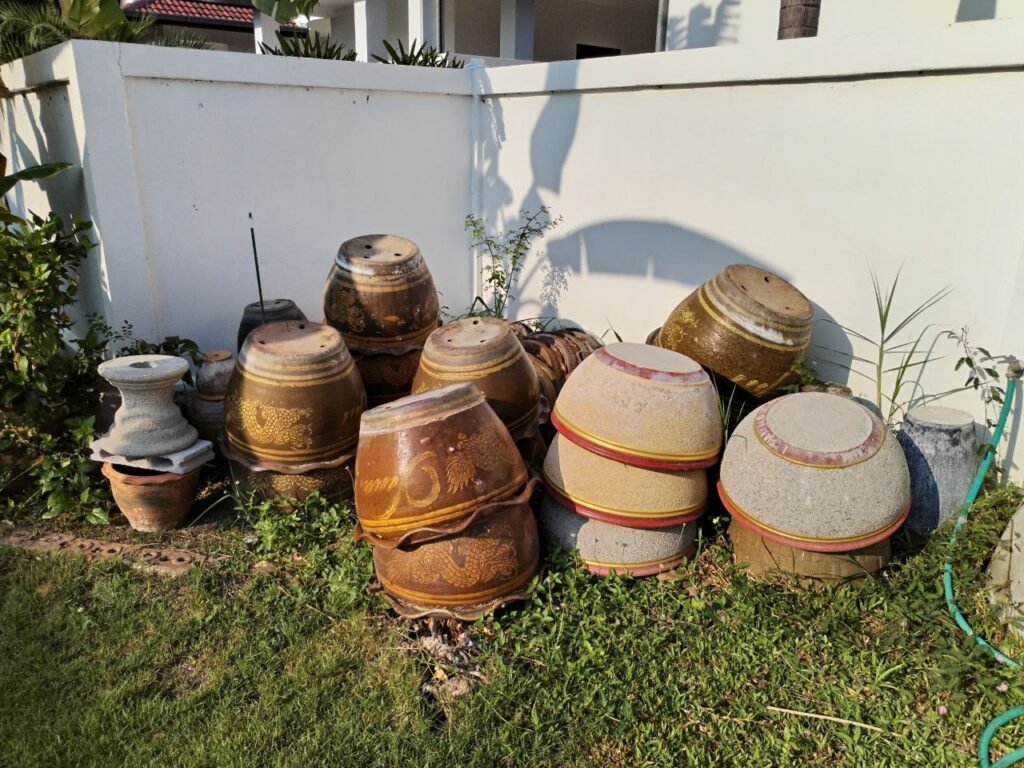
Drains – the overlooked breeding ground If standing water in pots is the appetiser, drains are the main course. An unused outdoor bathroom or shower drain that sits undisturbed for weeks is an ideal breeding environment – dark, damp, sheltered, and completely unbothered by whatever is happening in the rest of your garden.
We discovered this on our very first evening in our new property. The outdoor bathroom hadn’t been used in some time. The moment we turned on the shower, a cloud of mosquitoes came to life, apparently delighted by the sudden activity. Less delightful for us.
The fix is simple enough:
- Cover unused drains with drain covers – cheap, widely available, and deeply satisfying to install once you understand what’s living down there
- Pour a small amount of bleach down drains that aren’t regularly used, particularly outdoor ones
- Run water through unused showers and drains periodically – just enough to remind any potential residents that this is not a permanent arrangement
Pools and water features An unattended swimming pool is essentially a five-star mosquito resort – warm, sheltered, and full of stagnant water. Before we had our pool cleaned, it had been sitting with algae for a couple of months. A dragonfly had moved in, sensibly, to take advantage of the resulting mosquito buffet. The moment the pool was cleaned and circulating again, the dragonfly disappeared, presumably to find less well-managed premises.
The lesson: keep your pool circulating and treated. If you’re going away for any period, make sure someone is maintaining it. Two weeks of neglect in a tropical climate is all it takes to go from swimming pool to mosquito metropolis.
For smaller water features and garden ponds, the key is water movement. Mosquitoes prefer to lay eggs on still water, and even a gentle surface agitation from a small solar pump is enough to put them off. A basic 200 litre per hour solar pump costs very little and does the job quietly and without complaint – unlike most pest control solutions.
Shade and humid ground cover During the heat of a tropical day, mosquitoes rest in cool shaded spots – the undersides of large leaves, dense vegetation, shaded corners against walls. They’re not gone, they’re just waiting. Think of them as tiny, irritating shift workers clocking off until dusk.
This doesn’t mean ripping out all your shade plants, but it’s worth being aware of which spots are likely resting areas and avoiding lingering near them at dawn and dusk when they clock back on.
Wood chips and gravel around pathways and building perimeters are worth considering – they drain quickly, don’t accumulate moisture, and are noticeably less attractive to resting mosquitoes than grass or bare damp soil.
The door threshold – an underappreciated ambush point Here’s one that catches a lot of people out. In Thailand it’s customary to leave shoes outside the front door, which turns out to be genuinely sound mosquito logic – feet and footwear are strong mosquito attractants due to the bacteria on skin. A pile of shoes by the entrance is essentially a welcome mat for mosquitoes, and every time the door opens is an opportunity for one to assess the interior and decide it looks promising.
Be alert when opening doors at dusk in particular. The mosquito waiting patiently outside your door at 6pm is not there by accident.
Mosquito dunks – a targeted biological solution Sometimes standing water genuinely can’t be eliminated – a garden pond, a bird bath, a water feature you’ve spent actual money on. This is where mosquito dunks earn their place.
The active ingredient is Bacillus thuringiensis israelensis – a naturally occurring bacteria with the very specific and rather impressive ability to be toxic to mosquito larvae and essentially nothing else. Fish, guppies, birds, bees, beneficial insects – all unaffected. Your dog can drink from treated water. It is one of the very few pest control products that does exactly what it claims without collateral damage.
The mechanism is elegantly simple: place a dunk in standing water, mosquitoes lay their eggs there as usual, larvae hatch and feed on the bacteria, larvae die before reaching adulthood. The mosquito equivalent of a very long con.
One dunk treats a standard garden pond for around 30 days. Add it before you see larvae if possible – prevention is more efficient than cure. If you do spot larvae (small wriggling creatures just below the surface, impossible to mistake once you know what you’re looking for), add the dunk immediately. You have roughly four to five days from hatching before they mature and emerge as adults, at which point the opportunity has passed and they’re someone else’s problem – specifically yours.
SECTION 3: NATURAL PREDATORS
Here’s the thing nobody tells you when you move into a tropical garden: nature already has a perfectly functional mosquito control system. It was running long before you arrived, and with a little encouragement it will run long after you’ve put away the mosquito bat and stopped obsessing over drain covers.
The strategy in this section is simple – identify the creatures that eat mosquitoes, and make your garden somewhere they actually want to live.
Guppy fish – the unsung heroes of the garden pond
If you’ve never heard of guppies being used for mosquito control, you’re not alone. Most people think of them as decorative aquarium fish – small, colourful, faintly glamorous in a tropical sort of way. What’s less well known is that guppies are sometimes called “mosquito fish” for a very good reason.
Guppies are instinctive hunters of mosquito larvae. Put a guppy in water that contains larvae and it will go after them with genuine enthusiasm – not because it’s been trained to, but because larvae are essentially perfect guppy food. Soft-bodied, slow-moving, protein-rich, and conveniently located at the water surface. One observer described it as the aquatic equivalent of sushi. We call that a win win and the irony of the cycle of life does console us a little as we’re eating our favourite sushi.
Guppies have been used in public health programmes around the world – intentionally released into ponds, ditches, and water tanks specifically to control mosquito populations. They are, in short, doing important work and not getting nearly enough credit for it.
Setting up your guppy pond
You don’t need anything elaborate. A large flower pot, a half barrel, or a purpose-built container pond will do the job. Here’s what to keep in mind:
- Placement – partial shade is ideal. Morning sun and afternoon shade works well in a tropical climate. Full sun overheats the water and stresses the fish; full shade encourages stagnant conditions and algae
- Size – allow approximately 5 litres of water per fish as a minimum. A standard large flower pot pond will comfortably support a small colony
- Fish – start with hardy pet-grade guppies rather than expensive ornamental varieties. They’re tougher, cheaper, and frankly just as effective at eating larvae
- Acclimation – when you introduce new fish, float the bag in the pond water for 15 to 30 minutes before releasing them. This allows them to adjust to the water temperature gradually rather than being thrown in at the deep end, so to speak
- Feeding – in a garden pond with larvae present, guppies will largely feed themselves. Don’t overfeed with supplementary food as excess food decomposes and degrades water quality
We are in the process of setting up our own guppy ponds at the property here in Hua Hin, with rainy season approaching – we’ll be updating this guide with real results as our experiment develops.
One important note on dragonflies
If you’re planning both a guppy pond and a dragonfly-friendly water feature – and we’d encourage you to consider both – keep them separate. Dragonfly nymphs spend years developing underwater before emerging as adults, and fish will eat them. Your guppy pond and your dragonfly pond need to be two distinct features. More on dragonfly water features below.
Dragonflies – nature’s aerial pest control
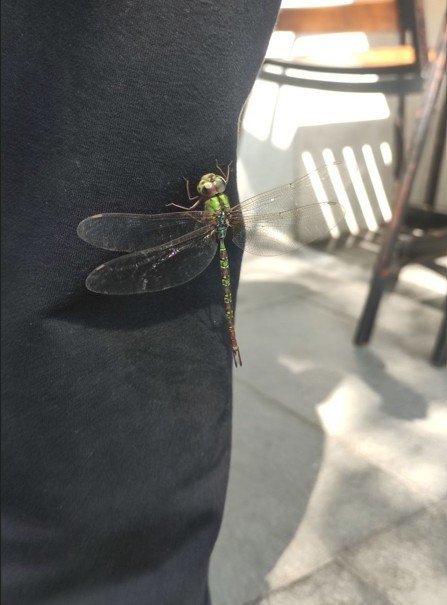
If guppies handle the larvae, dragonflies handle the adults – and they do so with extraordinary efficiency. A single adult dragonfly can eat up to 100 mosquitoes per day, or 30 times its own body weight in insects. A healthy population of dragonflies in a garden can reduce mosquito pressure to almost nothing. This is not folklore – it’s observable, and we observed it ourselves.
Before our pool was cleaned, it had been sitting neglected for a couple of months. A dragonfly had moved in, presumably delighted by the resulting insect activity. Once the pool was clean and treated, it left. At the time we noted it with mild interest. With hindsight it was a perfect illustration of how dragonfly behaviour tracks mosquito populations.
Dragonflies predate dinosaurs – scientists trace their origins back over 300 million years. They were managing insect populations long before we showed up with our electric bats and citronella candles, and they’re considerably better at it.
How to attract dragonflies to your garden
The good news is that in a tropical or subtropical climate like Thailand’s, dragonflies are already in your area. The challenge is giving them a reason to choose your garden over everywhere else.
Perches Dragonflies are ambush hunters. They need high vantage points to spot prey and launch from. Bamboo stakes placed around the garden are ideal – cheap, natural, and apparently irresistible to dragonflies at dusk when they’re hunting. Trellis wires and garden stakes work equally well. If you put them up, dragonflies will use them.
A suitable water feature Dragonfly nymphs need large, stable, shallow bodies of water to develop – and crucially, water without fish. A dedicated wildlife pond, even a modest one, gives them somewhere to breed and establishes a resident population. The key word is stable – a pond that dries out or gets cleaned regularly won’t support nymphs through their multi-year development cycle.
Ecosystem diversity Dragonflies don’t come to a bare lawn. They come to a garden that’s already alive – with flowers attracting other insects, trees providing shade and shelter, and enough biodiversity to sustain a food chain. The more your garden resembles a functioning ecosystem, the more dragonflies will treat it as home territory rather than a passing stop.
The counterintuitive truth here is that a garden with more insects overall will eventually have fewer mosquitoes, because the predators those insects attract – dragonflies included – will manage the populations naturally. The goal isn’t a sterile, insect-free garden. It’s a balanced one.
Don’t spray at the wrong time If you use any kind of spray in your garden, avoid doing so at dawn and dusk – precisely when dragonflies are most active and hunting. Spray after dark when dragonflies have retired for the evening, and aim low rather than misting upwards into the air.
Bats – the night shift
While dragonflies handle the daytime hunting, bats take over at night – which is, inconveniently, when mosquitoes are at their most active. A single bat can eat up to 1,000 mosquitoes per hour. Per hour. That number bears repeating.
A bat house mounted on a wall or post gives local bat populations somewhere to roost, and once established they will return year after year. Bat houses are simple to build from reclaimed timber if you’re handy, or inexpensive to buy. They require virtually no maintenance, make no noise, and work all night without any input from you whatsoever. For minimal effort they represent remarkable value.
Position bat houses at least 4 to 5 metres high, in a spot that gets morning sun to keep the roost warm, and away from bright lights which can deter bats from approaching.
Lizards and birds
While we’re on the subject of creatures doing useful work on our behalf – lizards deserve a mention. Our garden lizard appeared on day four of moving in, regarding us with the calm confidence of someone who has been here considerably longer than we have, which is true. Lizards eat mosquitoes, gnats, and a wide variety of other insects. Encourage them. Don’t disturb their habitats. They are on your side.
Insectivorous birds – swallows, martins, and similar species – are also worth attracting with appropriate feeders and nesting boxes. Watching swallows hunting at dusk over a garden is, incidentally, one of the more genuinely entertaining things a garden can offer. Better than most television.
A note on what doesn’t work
Since we’re talking about natural predators, this is a good moment to address the dragonfly clip – a small plastic dragonfly you attach to your hat or clothing, on the theory that mosquitoes will be frightened away by the presence of a predator.
It does not work. We know this because someone sat in a field wearing one and got absolutely destroyed by mosquitoes while it dangled uselessly from their cap. The mosquitoes were not fooled. Real dragonflies work. Plastic ones do not.
SECTION 4: PHYSICAL BARRIERS AND DETERRENTS
Eliminating breeding sites and encouraging natural predators are your long-term strategies. This section is about the more immediate, practical measures – the things that stand between you and a mosquito that has already decided it likes the look of you.
Think of it as your personal defence layer. Not glamorous, but necessary.
Mosquito nets – unglamorous, highly effective
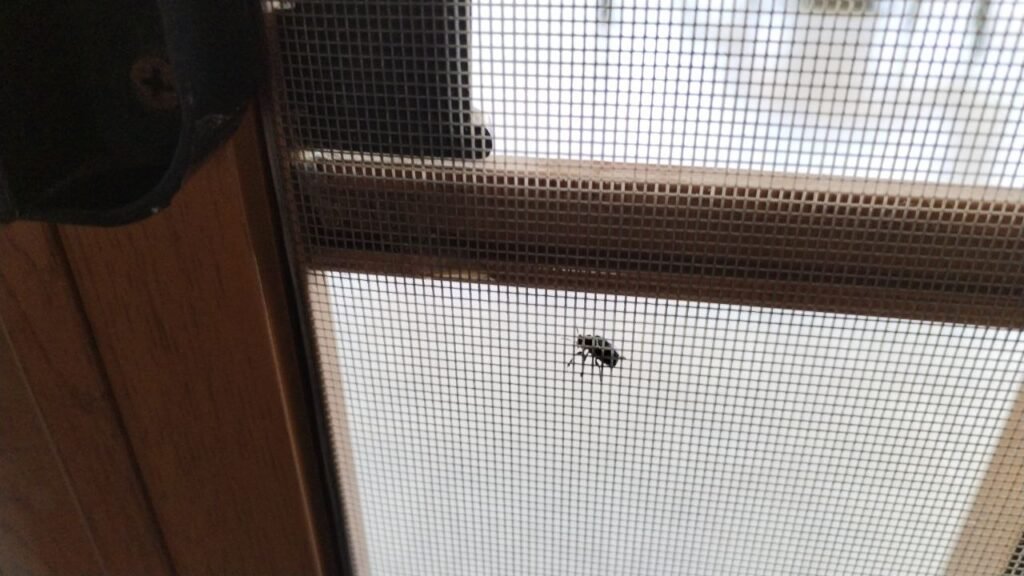
There is nothing exciting to say about mosquito nets. They are not sophisticated. They do not require batteries or special installation. They work by being a physical barrier between you and something that wants to bite you, which is about as low-tech as pest control gets – and that is precisely why they’ve been used successfully for centuries.
For windows and doors, fixed mesh screens are the gold standard. If your property doesn’t have them, adhesive magnetic mesh screens are a reasonable compromise and can be fitted without tools. For sleeping, a bed net is the single most effective way to guarantee an undisturbed night – particularly important in the early weeks in a new tropical property before you’ve had a chance to implement the broader strategies in this guide.
A note on gaps: a net with a hole in it is considerably less useful than no net at all, because mosquitoes will find the hole and then you’ve created a situation where they’re trapped inside the net with you, which is arguably worse than having no net. Check regularly for damage.
The shower trick – flushing out bathroom mosquitoes
This one comes directly from our own experience and we’ve not seen it written down anywhere else, which is exactly the kind of thing that makes a guide worth reading.
If you suspect mosquitoes are resting in your bathroom – particularly an outdoor bathroom, or one that hasn’t been used for a while – turn the shower on before you go in. The sudden moisture and movement appears to activate resting mosquitoes, bringing them out of hiding and into the open where they’re considerably easier to deal with. Armed with a mosquito bat, a pre-shower sweep of an outdoor bathroom takes thirty seconds and can save you several bites.
We discovered this by accident on day one at our new property. We now consider it standard procedure.
Mosquito bats – satisfying, effective, and a genuine workout
If you haven’t yet experienced the deeply satisfying crack of a mosquito bat making contact, you have something to look forward to. These electric rackets zap mosquitoes on contact and are particularly useful for indoor situations where a single mosquito is making everyone’s evening miserable.
A few practical notes from experience:
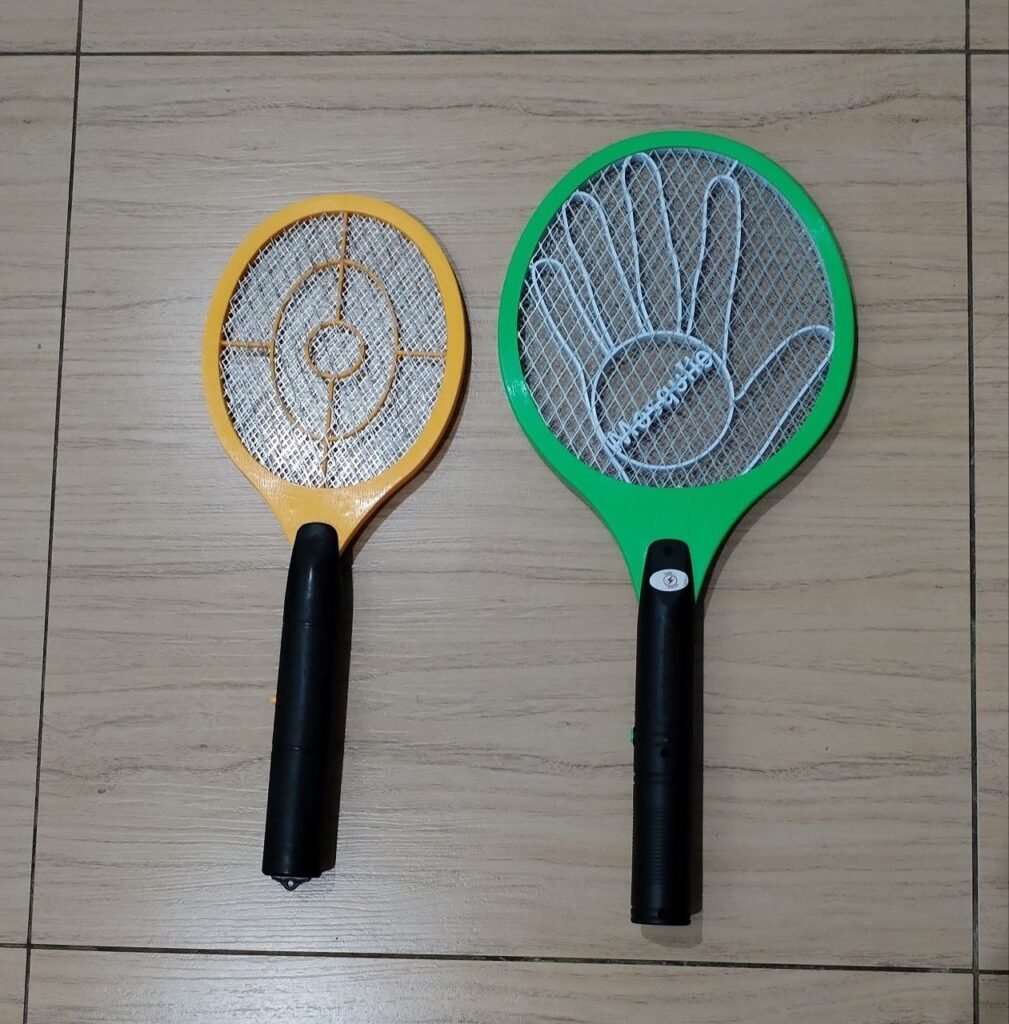
- Head size matters – a larger head means a greater surface area and a higher chance of making contact. This sounds obvious but many bats are surprisingly small
- Weight matters too – a larger head usually means a heavier bat, which becomes relevant if you’re swinging it repeatedly or if older family members are using it. A bat that causes pain or is tiring to hold is a bat that gets put down, at which point the mosquito wins
- The sweet spot – a medium-large head with a comfortable grip is the ideal combination. We’ve tested a few and the difference is noticeable
- Charge them – rechargeable models are more economical and environmentally sensible than battery-powered ones – we’ve also found that the rechargeable bats seem to carry a stronger charge so may be more effective
For indoor use, the mosquito bat is probably your most reliable immediate-response tool. For outdoor use, the coverage area is limited and you’ll exhaust yourself trying to bat your way through a tropical dusk. In that scenario, the strategies in the other sections are doing the heavy lifting.
Clothing – the simplest repellent of all
Mosquitoes are attracted to dark colours, body heat, and exposed skin. Light-coloured, loose-fitting, long-sleeved clothing at dawn and dusk is a genuinely effective deterrent – particularly for the feet and ankles, which are disproportionately targeted due to the bacteria on skin.
This is also where permethrin-treated clothing earns a mention. Permethrin is a synthetic compound that, when sprayed onto fabric and allowed to dry, repels and kills mosquitoes on contact with the treated material. It doesn’t protect exposed skin, but anything covered by a treated shirt or trousers is essentially off-limits. It’s particularly effective for outdoor evening situations where other methods aren’t practical.
One important note: permethrin is toxic to cats. If you have cats, check current guidance carefully before using it around your home.
Incense sticks – a practical outdoor option
For outdoor sitting areas at dusk, incense sticks – particularly lemongrass and citronella varieties – provide a genuine, if modest, deterrent. The mechanism is essentially the smoke rather than the specific fragrance, which is worth knowing because it means almost any smouldering incense provides some benefit.
In practical testing, lemongrass and citronella incense sticks performed noticeably better than citronella candles – more smoke output relative to size, longer burn time, and a wider effective area. Light them ten minutes before you plan to sit outside and position them upwind of where you’ll be sitting.
Incense sticks and coils both work on the same principle – it’s the smoke rather than the specific fragrance doing the work. Sticks are easier to handle and position; coils burn longer. We’ve linked both options in our Garden Toolkit.
The downside, as with anything that produces smoke, is that you probably don’t want to be directly inhaling it for extended periods. Position them thoughtfully rather than placing them right next to your chair.
Smouldering coffee grounds – surprisingly effective, with caveats
This one raised our eyebrows too, but the evidence is reasonable. Used coffee grounds placed in a heatproof dish and set smouldering produce smoke that mosquitoes find genuinely deterring – more effectively than a citronella candle in direct comparison testing.
The catch is the same as incense: it’s the smoke doing the work, and smoke in quantity isn’t great to inhale. Use it in well-ventilated outdoor settings, positioned upwind, and don’t expect it to clear a large area. Think of it as a free, zero-waste addition to your outdoor evening setup rather than a primary control method.
Also worth noting: freshly brewed coffee in the morning remains entirely unaffected by this information. Your breakfast is safe.
The Thermacell – when you need the heavy artillery
For situations where other methods aren’t cutting it – a particularly bad evening, a large outdoor area, guests who haven’t yet developed your philosophical acceptance of tropical insect life – the Thermacell device is worth knowing about.
It uses a small butane cartridge to heat a pad containing allethrin, which disperses into approximately a 15-foot radius and is highly effective at clearing that area of mosquitoes. It produces very little visible smoke and works within about five minutes of switching on.
The caveats: it’s not a natural solution, the cartridges are a running cost, and you shouldn’t be directly inhaling whatever it’s dispersing even though it’s not visibly smoky. Use it outdoors, don’t sit directly over it, and treat it as an occasional tool for high-pressure situations rather than an everyday solution.
It’s also worth noting that allethrin, like most insecticides, is non-selective – so use it away from water features, flowering plants, and areas where beneficial insects are active.
What doesn’t work – and is worth knowing
Since we’ve covered the things that do work, a brief and honest tour of the things that don’t:
- Citronella candles – the smoke helps marginally, the citronella itself does very little. You’d need to sit inside a citronella candle for it to make a meaningful difference, which is not recommended
- Ultrasonic frequency apps – tested, abandoned, did not work. The mosquitoes were not impressed
- Citronella wristbands – the coverage area is approximately your wrist. Everything else remains unprotected
- Bug patches and stickers – tested under real conditions, ineffective
- Dryer sheets tucked around your collar – we mention this purely because someone genuinely tested it. It did not work
The pattern across all of these is the same: they sound plausible, they’re satisfying to purchase, and mosquitoes are entirely unbothered by them. Save your money for drain covers and mosquito dunks.
SECTION 5: NATURAL REMEDIES AND TREATMENTS
Despite your best efforts – the drain covers, the guppy pond, the bamboo stakes for the dragonflies, the pre-shower bat sweep that your housemates now accept as completely normal behaviour – you will still occasionally get bitten. This is tropical living. It comes with the territory, quite literally.
This section covers what to do when prevention hasn’t been enough, plus a couple of additional control tools that didn’t fit neatly elsewhere.
Ovitraps – turning their instincts against them
An ovitrap is a deliberately attractive egg-laying site that you control. The concept is elegantly simple: provide mosquitoes with what looks like the ideal breeding environment, let them lay their eggs there, and then either destroy the eggs or treat the water so the larvae never survive to adulthood.
The basic DIY version requires nothing more than a dark-coloured container, some organic matter – grass clippings, hay, dried leaves – and water. Dark containers are preferred because mosquitoes are attracted to darker water, which in nature signals the kind of stagnant, sheltered conditions ideal for larvae. The organic matter encourages the growth of microorganisms that mosquito larvae feed on, making the trap even more attractive.
Once you see larvae – small, wriggling creatures just below the surface, usually appearing within a week in tropical conditions – add a mosquito dunk. The larvae feed on the bacteria, and that’s the end of that generation.
The strategic insight here is placement: position ovitraps at the perimeter of your property rather than near the house. You’re drawing mosquitoes toward the trap and away from where people are. Think of it as redirecting their ambitions rather than confronting them directly.
One practical note: if you’re setting up ovitraps, make sure they genuinely are the most attractive option available. Eliminate competing standing water around the property first – otherwise you’re just adding one more breeding site to an existing selection, which rather defeats the purpose.
Bait stations – the CO2 con
Mosquitoes locate their targets largely by following carbon dioxide – the CO2 we exhale with every breath. Bait stations exploit this by generating CO2 through the fermentation of sugar and yeast, luring adult mosquitoes in and killing them with a saltwater solution they consume on arrival.
The setup is straightforward: sugar, yeast, water, and salt in a container with entry holes. Mosquitoes enter, feed, and die within a couple of days. Position them at the garden perimeter – the same logic as ovitraps, drawing activity away from where people gather.
Commercial versions are available, or you can make your own with a two-litre bottle and basic ingredients. Replace the mixture approximately every 30 days as the fermentation activity diminishes.
A note of honesty here: bait stations work better as part of a broader strategy than as a standalone solution. They’re most effective when breeding sites have already been reduced, because the station then becomes one of relatively few attractive options available to mosquitoes in your garden.
When you do get bitten
Even in a well-managed tropical garden, the occasional bite is inevitable. A few things that actually help:
Antihistamines For significant reactions – swelling, persistent itching, discomfort that’s affecting sleep – an oral antihistamine is the most effective response. We recommend keeping a supply at home and topping up whenever you run low, you really don’t want to wake up in the middle of the night ravaged my mosquitoes and not have one to hand. In Thailand they’re widely available over the counter and inexpensive and some people find they need them regularly when first arriving in a new tropical environment before their immune response settles down.
A non-drowsy antihistamine such as cetirizine works well during the day; diphenhydramine (Benadryl) is better suited for nighttime when the drowsiness becomes a bonus rather than a problem. Both are widely available over the counter.
Antihistamine creams applied directly to bites reduce itching and swelling locally. They work best applied promptly rather than after prolonged scratching – which, easier said than done, but worth attempting.
The heat pen This is a small handheld device that applies a brief pulse of concentrated heat directly to a bite. The theory is that heat denatures the proteins in mosquito saliva that cause the allergic reaction – the itch and swelling. Does it work?
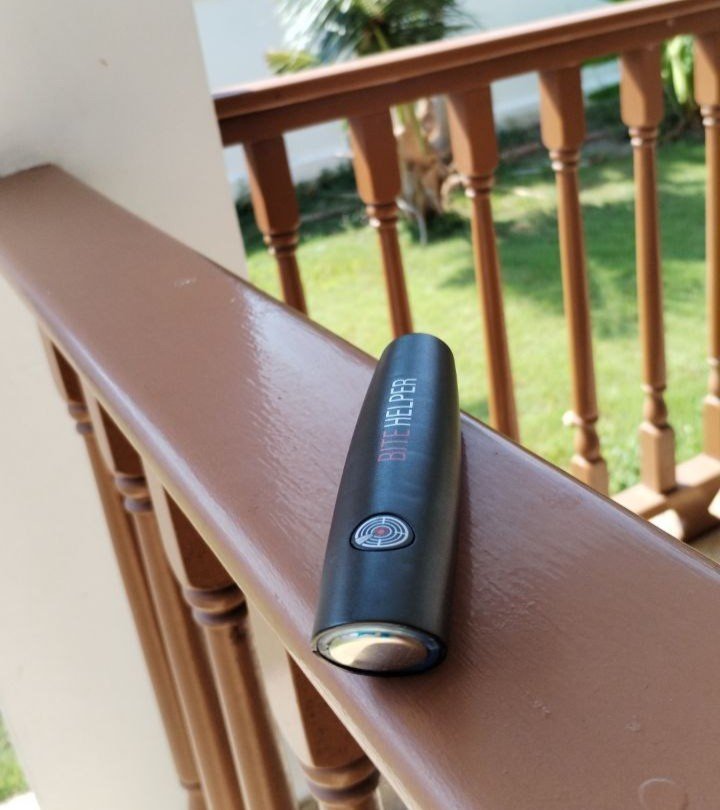
Our honest assessment after testing: it takes the edge off, particularly if applied quickly after a fresh bite. Whether that’s the heat mechanism working as described or simply the distraction of pressing a warm device onto your skin is genuinely unclear to us. It’s not a miracle, but for people who react badly to bites it’s a reasonable addition to the toolkit. Compact, reusable, and no ongoing costs once you have one.
Cold compress Simple and effective for immediate relief – a cold damp cloth or ice pack reduces swelling and temporarily numbs the itch. Not a solution, but a comfort measure while other treatments take effect.
Don’t scratch We include this advice fully aware that it is the least followed advice in the history of pest control. Scratching breaks the skin, introduces bacteria, prolongs healing, and in a tropical climate where minor skin irritation can escalate quickly, it’s genuinely worth making the effort to resist. Apply a topical treatment, take an antihistamine if the reaction is significant, and find something else to do with your hands – even if it is stalking around with your mosquito bat looking for the perpetrator
Monitoring – building a picture over time
One of the most useful things you can do in the early weeks and months in a new tropical property is simply pay attention and note what you observe. When are bites happening – morning, evening, during the night? Where – indoors, outdoors, near particular parts of the garden? Which control measures seem to make a difference and which don’t?
This kind of observation builds into genuinely useful pattern recognition. You’ll start to notice, for example, that the corner of the garden near the large tree is reliably worse at dusk, or that the indoor bites stopped after you sorted the bathroom drain, or that the guppy pond has visibly reduced larvae in the nearby water feature.
We’ve been keeping a journal of exactly this kind since moving in, and it’s already produced several observations that have directly shaped this guide – the shower trick, the drain covers, the shoe door risk. None of that came from research. It came from paying attention.
The other benefit of monitoring is knowing when to escalate. Natural methods are effective and we advocate for them strongly, but there are circumstances – dengue fever in the local area, a significant infestation that isn’t responding to natural methods, a vulnerable family member with serious reactions – where professional pest control becomes the responsible choice. Knowing your garden well enough to recognise when something has changed is how you make that call at the right time rather than too late.
CONCLUSION
If you’ve made it this far, you now know considerably more about mosquitoes than most of your neighbours – and probably more than you ever expected to when you first moved into your tropical garden.
The good news is that the full picture, while detailed, reduces to a surprisingly straightforward set of priorities. Get these right in order and you’ll notice a meaningful difference:
Start with prevention. Eliminate standing water, sort your drains, cover what can’t be emptied, and add mosquito dunks to anything that remains. This single step disrupts the breeding cycle and costs almost nothing. Everything else builds on this foundation.
Invite the right residents. Set up a guppy pond, put up bamboo stakes for the dragonflies, consider a bat house for the night shift. These are one-time investments that pay dividends indefinitely. Nature’s pest control system is older and more efficient than anything you’ll find in a hardware store – it just needs a little encouragement to get established.
Put your barriers in place. Nets on windows and doors, a mosquito bat for indoor emergencies, sensible clothing at dusk. Not exciting, unfailingly effective.
Know what works outdoors. Incense sticks, the Thermacell for high-pressure situations, perimeter traps drawing activity away from where you actually spend time.
Be honest about what doesn’t work. Citronella candles, wristbands, frequency apps, plastic dragonfly clips – save your money and your optimism for something that will actually make a difference.
And when you do get bitten – because you will, at least occasionally – antihistamines, topical cream, a heat pen if you’ve found it helpful, and the hard-won wisdom to not scratch. Tropical living rewards patience in all its forms.
A final thought worth sharing. When we moved into this property, we arrived with a general awareness that mosquitoes would be an issue and a vague plan to deal with them. What we didn’t expect was how quickly observation and attention would start producing genuinely useful knowledge – the shower trick on day one, the drain cover realisation on day three, the pool and dragonfly connection shortly after.
A tropical garden is a living system, and mosquito control is really just one aspect of understanding how that system works. The guppy ponds aren’t set up yet. The dragonfly population is a work in progress. Rainy season is approaching, which will test everything in this guide under real conditions and no doubt add several chapters worth of new observations.
We’ll update this guide as we learn. That’s the point of it.
In the meantime – good luck, stay observant, and invest in a decent mosquito bat. Head size matters more than you’d think.